
 By
By Conversations about real estate is not just about the location, it’s also about the street, the neighbourhood, the proximity to a metro station. I think about this often, sitting at the overlap of two businesses that most people would never put in the same sentence.
One builds homes and commercial spaces. The other works in biotechnology, producing bio-based solutions for agriculture and aquaculture. On the surface, no connection but if you dig an inch deeper, and you find that biotech is one of the most powerful and the most underappreciated drivers of real estate demand in the modern economy.
Biotech and life sciences activity does not just create jobs, it creates a whole ecosystem that reshapes land use, commute patterns, commercial requirements, and residential behaviour for a radius far wider than anyone initially anticipates.
Look at what happened in Boston’s Kendall Square corridor, or Hyderabad’s Genome Valley. These did not start as real estate plays. They started as science parks which was anchored by research institutions or government incentives and then, almost organically, the surrounding land began to change. Labs needed support services. Researchers needed housing. Suppliers needed proximity. People needed cafes, clinics, creches, co-working spaces.
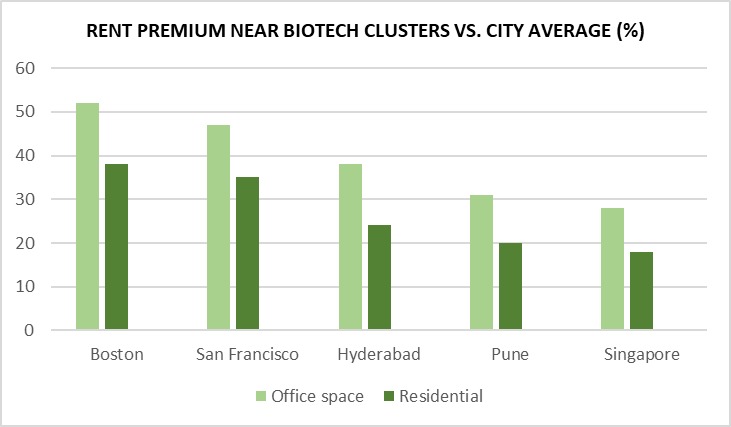
The chart captures what this translates to in rental terms. Office space near established biotech clusters commands a premium of anywhere between 28 and 52 percent over city averages. Residential is not far behind, running 18 to 38 percent higher depending on the market.
Why Indian Markets Are at a Turning Point
Hyderabad has been the clearest example. Genome Valley, which started as a government initiative more than two decades ago, has matured into one of Asia’s most significant life sciences clusters. The commercial absorption numbers from Hyderabad is now heading toward 11 million sq ft annually and these are no accident. They track the expansion of pharma and biotech campuses almost point for point. Residential demand in Kondapur, Gachibowli, and the surrounding nodes has followed with a reliability that any property investor would envy.
Pune is telling a similar story. Hinjewadi and the life sciences presence building around it is generating the kind of commercial demand that takes years to fully register in data but is already visible on the ground to anyone paying attention.
And then there is Mumbai MMR, a little slower off the mark, because the geography is harder and the legacy infrastructure more complex. But the trajectory is now unmistakable.
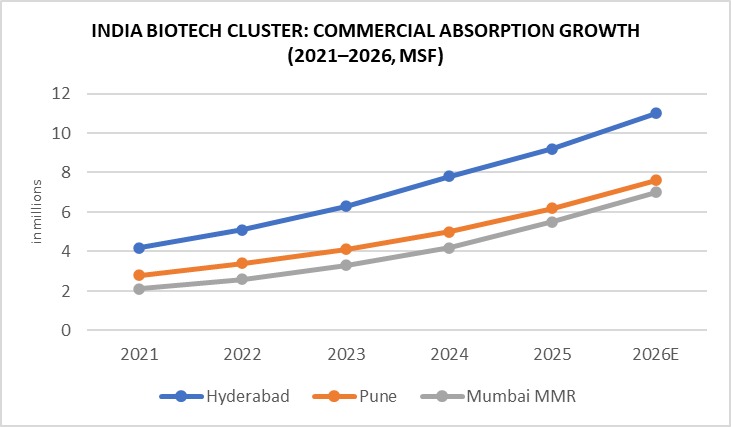
The chart shows Mumbai MMR’s commercial absorption nearly tripling over five years. Some of that is general economic growth. A meaningful part of it is the gradual but real migration of biotech, pharmaceutical, and life sciences operations toward locations in the extended MMR places like Thane, Navi Mumbai, and increasingly, the Vasai–Raigad corridor.
The Relationship Between People and Where They Want To Locate
Biotech people particularly the younger cohort of researchers, fermentation engineers, data scientists working on genomics are not making location decisions the way previous generations did. They are not automatically gravitating toward the traditional commercial centres. Many of them are actively choosing peripheral locations that offer better housing value, cleaner environments, and shorter commutes, and then expecting their employers to follow.
This is exactly what is happening in the Vasai-Virar corridor, which is how it connects to Techton’s work. The families buying in Akhand are not all software engineers commuting to Andheri. A growing share are professionals in pharma, in manufacturing, in biotech-adjacent industries; all of those people who want what we built i.e. space, community, proximity to their own growing cluster of workplaces. When a biotech or pharmaceutical company sets up near an MIDC in Vasai or Boisar, it triggers a housing search in exactly the corridor where we are building.
I did not plan for TerraPHA to be a demand generator for Techton Life Spaces. But the geography of Indian biotech is making it exactly that, and I do not think that pattern is unique to us.
What This Means for Anyone Thinking About Property
The biotech cluster as a real estate demand driver is still early in its India story. Hyderabad is mature. Pune is mid-cycle. Mumbai MMR and its extended corridors like Thane, Navi Mumbai, Vasai, Raigad are early. Early is where the best risk-adjusted returns are made, provided you understand what you are tracking. Track the MIDC allocations. Track the greenfield pharma park announcements. Track where research institutions are expanding or where government life sciences incentives are landing. Then look at the residential and commercial land within a 15-30 km radius. That land will not stay priced the way it is today.