 By
By I have spent parts of my life watching transfer of property, skylines shift, ambitions rise and people’s dreams being fulfilled. But I have never seen a year quite like 2026. The foundation of many businesses in commercial real estate is changing rapidly.
Let me be direct, the previous method of doing business is dead or rather say the old playbook is obsolete. The developer who is still chasing the same square-footage metrics from 2019 is building for a world that no longer exists. That may sound harsh. But from where I stand, watching the Mumbai Metropolitan Region as it expands, what I see is not a crisis. It is a correction, and beyond it, an extraordinary opportunity.
This is not an industry report. This is what I genuinely believe, based upon many conversations I have had with buyers, tenants, investors, and the families who will actually live and work in the spaces we are building.
Commercial Spaces
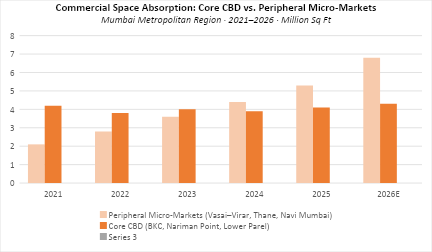
In 2026, the conversation is no longer “will offices survive?” They have. But they have transformed. The Grade A office parks in Mumbai’s secondary corridors (Vasai, Virar, Mira Road) are filling up in ways I genuinely did not anticipate even three years ago.
Why?
Because the math changed. A company with 80 employees does not need a 12,000 sq ft floor in BKC when it can have a beautifully fitted, well-connected workspace in Vasai East at 40% of the cost, with employees who now live ten minutes away rather than commuting 90.
“The decentralisation of commercial activity is not a threat to real estate. It is the single greatest expansion of the market I have seen in my lifetime.”
Absorption rates in peripheral micro-markets across India’s top six cities have climbed consistently while core CBD vacancy has stalled. The smart money has already begun rotating. And more importantly, the smart developers are already there and they’re building.
A Space That Cannot Be Experienced Is a Space That Cannot Be Sold.
This is something I tell every architect that a space that cannot be experienced is a space that cannot be sold. Especially not in 2026. Not anymore.
The end-user, whether it is a business leasing 5,000 sq ft or a family buying a home in an integrated township, they all want to feel something the moment they step inside. They want air. They want light. They want community. They want to believe that the builder cared for them and not just calculated the squares and amounts.
When we designed Akhand in Vasai, with its nine towers and a foundation built around genuine community that includes common greens, flexible amenity spaces, proximity to everything; we were not being idealistic. We were reading the market correctly. The commercial component of a well-designed township does not compete with standalone office parks. It serves a different need which is the desire to work close to where you live, in an environment that doesn’t feel like a compromise.
Smart Infrastructure Is No Longer a Feature
Five years ago, a developer could advertise “smart home technology” and buyers would lean in, impressed. Today, a buyer walking through a show apartment in Vasai East expects app-controlled utilities, EV charging in the basement, solar offsets on the terrace, and fiber to every unit as a baseline and not a selling point.
“A baseline.”
The same logic applies to commercial spaces. A tenant in 2026 is not impressed by air conditioning and a pantry. They want occupancy-sensing, adaptive lighting, air quality monitoring, and layouts that can flex between collaborative zones and heads-down desks within hours. If your building cannot offer that then you’re not offering an asset.
We thought hard about this at Techton. When we build, we are not just pouring concrete. We are laying infrastructure for the next 30 years. The pipes, ducts, conduits, and structural decisions we make today determine what can be retrofitted tomorrow. That is a responsibility I do not take lightly, and it shapes every specification we write.
“The buildings that will command rents in 2036 are being designed and mis-designed right now. The difference will come down to who understood that infrastructure is invisible until it isn’t.”
The Term: Sustainability
I have sat in enough boardrooms to know what “sustainability” has meant to most developers. A line item to minimise, a few solar panels for the brochure, maybe a GRIHA rating if the lender requires it.
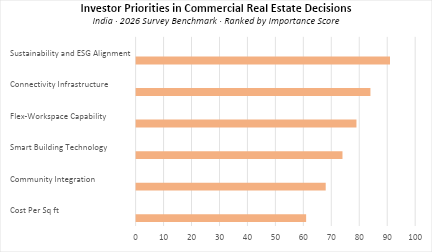
In 2026, institutional capital whether from REITs, family offices, or international funds is applying ESG screens that were unimaginable five years ago. Buildings that cannot demonstrate measurable energy efficiency, water harvesting, and lifecycle carbon targets are being walked away from, regardless of location or price. This is not ideology. This is yield protection.
But beyond capital markets, there is a simpler truth that tenants want to be in buildings that reflect their values. A company telling its employees it is committed to sustainability cannot do so from a building with a 40-year-old central HVAC and no green certification. The mismatch becomes a recruitment and retention problem. And in 2026, no business can afford that.
I do not say this because we are building in Vasai. I say it because I have been watching this corridor for fifteen years, and the infrastructure commitments that have landed here, the Virar-Alibaug Multi-Modal Corridor, the Vasai–Diva rail upgrades, the NAINA node developments represent a generational inflection.
The Next Wave
What Thane was to the early 2000s, Vasai East is to this decade. The difference is that this time, the buyers are more sophisticated, the regulatory environment is sharper with MahaRERA providing accountability, and the developers who are serious have had to raise their game accordingly.
Commercial real estate in this corridor will follow residential, as it always does but faster than most expect. The office market will not wait five years this time. It will chase the talent pool that is already moving here, the families who are choosing quality-of-life over a central address and refusing to be embarrassed about it.
If there’s anything I’d defend without hesitation or the things I would stake my reputation on, they would be these.
Mixed-use is the future of commercial development. The lines between where people live, work, shop, and recover are dissolving. The buildings and campuses that weave all of these together intelligently, not superficially will appreciate in ways that single-use assets simply cannot match.
The rise of peripheral micro-markets is not tied to short-term cycles. It reflects a deeper structural transformation. Permanent infrastructure growth, genuine talent migration, and sustainable cost efficiencies ensure its momentum will continue.
Quality will polarise the market. There will always be a buyer for cheap. But the gap between “good enough” and “genuinely excellent” is widening; in price, in demand and in long-term value. Every decision we make at Techton is an attempt to stay on the right side of that gap, because we believe the market rewards it, and frankly, we would not know how to build the other way.
And finally, the community is commercial. The most undervalued asset in real estate right now is not a location or a specification. It is the sense that when you walk through a gate or into a lobby, you belong to something. We built Akhand’s three towers: Ira, Isa, Ora as an expression of that belief. Creator, divine, present. The names are not decorative. They are a statement of intent about what we think a home, a neighbourhood, a commercial ecosystem should offer and that is the conditions for a life fully lived.